Legally Taking Drone Photos
Legally Taking Drone Photos: A Guide for Real Estate Professionals
How to Legally Take Commercial Drone Photos: What You Need to Know
Using drones for photography has exploded in popularity, becoming a standard expectation for real estate listings, roof inspections, and small business marketing. But the moment you use a drone to aid a business—whether you are the pilot or the real estate agent hiring one—you step out of the "hobby" world and into FAA-regulated federal airspace.
Many agents and photographers assume that because they bought a drone, they can fly it over a listing. This assumption can cost you thousands of dollars.
Here’s a straightforward breakdown of what is legally required and the financial consequences of ignoring FAA regulations.
1. You Need an FAA Part 107 License
The most common myth is that you only need a license if you are a "full-time" drone pilot. This is false.
If the flight furthers a business in any way—even if no money changes hands (e.g., a favor for a friend who is listing a house, or taking photos for your own portfolio)—the FAA classifies it as a commercial operation. To do this legally, the pilot must hold a current FAA Part 107 Remote Pilot Certificate.
What Part 107 Certification Requires:
Passing a Federal Exam: The pilot must pass a 60-question aeronautical knowledge test at an FAA-approved testing center (cost is typically around $175).
Vetting: All licensed pilots undergo a TSA background check.
Recurrency: Pilots must complete safety training every 24 months to remain valid.
What This License Allows:
Legal Commercial Flights: You can legally sell your photos or use them for marketing.
Airspace Access: Licensed pilots can request "LAANC" authorization to fly in controlled airspace (near airports) where hobbyists are often banned.
Liability Protection: It is the first layer of defense in court if an accident occurs.
2. You Must Register Your Drone With the FAA
If you are using a drone for any business purpose—whether for real estate, inspections, or marketing—it must be registered with the Federal Aviation Administration (FAA). This is a federal requirement for every aircraft used commercially, regardless of its size, weight, or model.
Registration is a mandatory step that links the aircraft to you (or your business) as the responsible party.
Key Registration Requirements:
Mandatory for Business: Every drone used for commercial work must be registered individually through the FAA DroneZone portal.
Cost & Validity: The fee is $5 per drone, and the registration is valid for 3 years.
Proper Labeling: You are legally required to physically mark the drone’s exterior with its unique FAA registration number.
Remote ID Compliance: As of 2024, most registered commercial drones must comply with Remote ID regulations. This means the drone must broadcast a digital "license plate" signal that allows law enforcement to identify the aircraft and control station in real-time.
3. The Consequences: It’s Not Just the Pilot Who Pays
What happens if you fly illegally, or if you hire an unlicensed pilot to save money? The risks go far beyond a slap on the wrist.
If You Are the Pilot:
Civil Penalties: The FAA can issue fines of up to $1,100 per violation. A single flight often racks up multiple violations (e.g., flying without a license + flying unregistered + flying in controlled airspace), leading to fines exceeding $10,000.
Criminal Charges: In cases of recklessness or flying near critical infrastructure, you can face criminal charges and up to 3 years in prison.
If You Are the Real Estate Agent (The Hiring Party):
Vicarious Liability: If you hire an unlicensed pilot, you can be held liable. The FAA has previously proposed fines of $11,000 for agents who knowingly hire unlicensed operators.
Insurance Void: Standard business liability policies almost always have an "aviation exclusion." If your unlicensed nephew crashes a drone into a client’s window—or worse, a person—your general liability insurance will likely deny the claim, leaving you personally sued for damages.
Final Thoughts
Commercial drone photography is an incredible tool that adds massive value to listings. However, the barrier to entry is higher than just buying a drone.
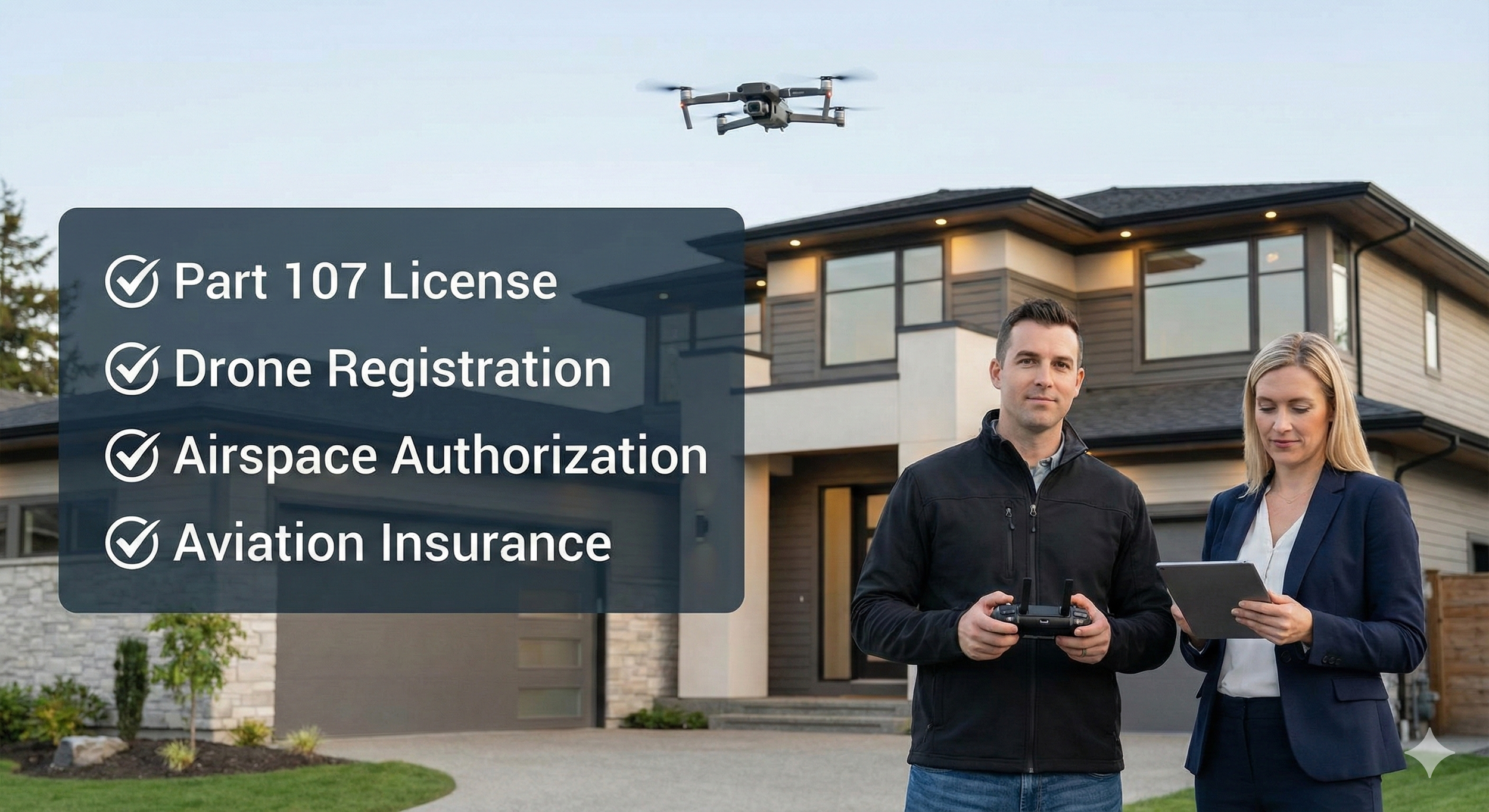
The Checklist for Legal Flights:
✔ Part 107 License: Verify your pilot has a physical card or temporary certificate.
✔ Drone Registration: Ensure the drone has an FAA number on it.
✔ Airspace Authorization: Confirm the location isn't a No-Fly Zone.
✔ Aviation Insurance: Verify specific drone liability coverage.
Don’t Take the Risk—Let a Professional Handle It
Cutting corners with drone photography can lead to five-figure fines, voided insurance, and lawsuits. It is simply not worth the risk to save a few dollars.
Insley’s Drone Service is FAA Part 107 certified, fully insured, and compliant with all federal regulations. We handle the airspace authorizations and safety checks so you can focus on selling the property.
Reach out today to schedule a safe, legal, and stunning aerial shoot.